

IT COLLECTIVE AGREEMENT 2027

IT COLLECTIVE AGREEMENT 2027

IT IS BETTER
TOGETHER!

IT IS BETTER
TOGETHER!

Together for a successful IT collective agreement!

Join our growing ‘IT’ movement and support the negotiations!

Collective agreements can only be secured with active employees and a strong trade union. Last year, many IT employees backed the negotiating team. The more of us there are, the greater our impact:

  • No works council at your company? Set one up with support from the GPA Union!

  • Get involved in activities organised by IT employees to support the negotiations!

  • Not yet a member of the GPA Union? Join us, as many IT employees have recently done, and you’ll be on the safe side! 

Sign up for our Newsletter to stay updated!
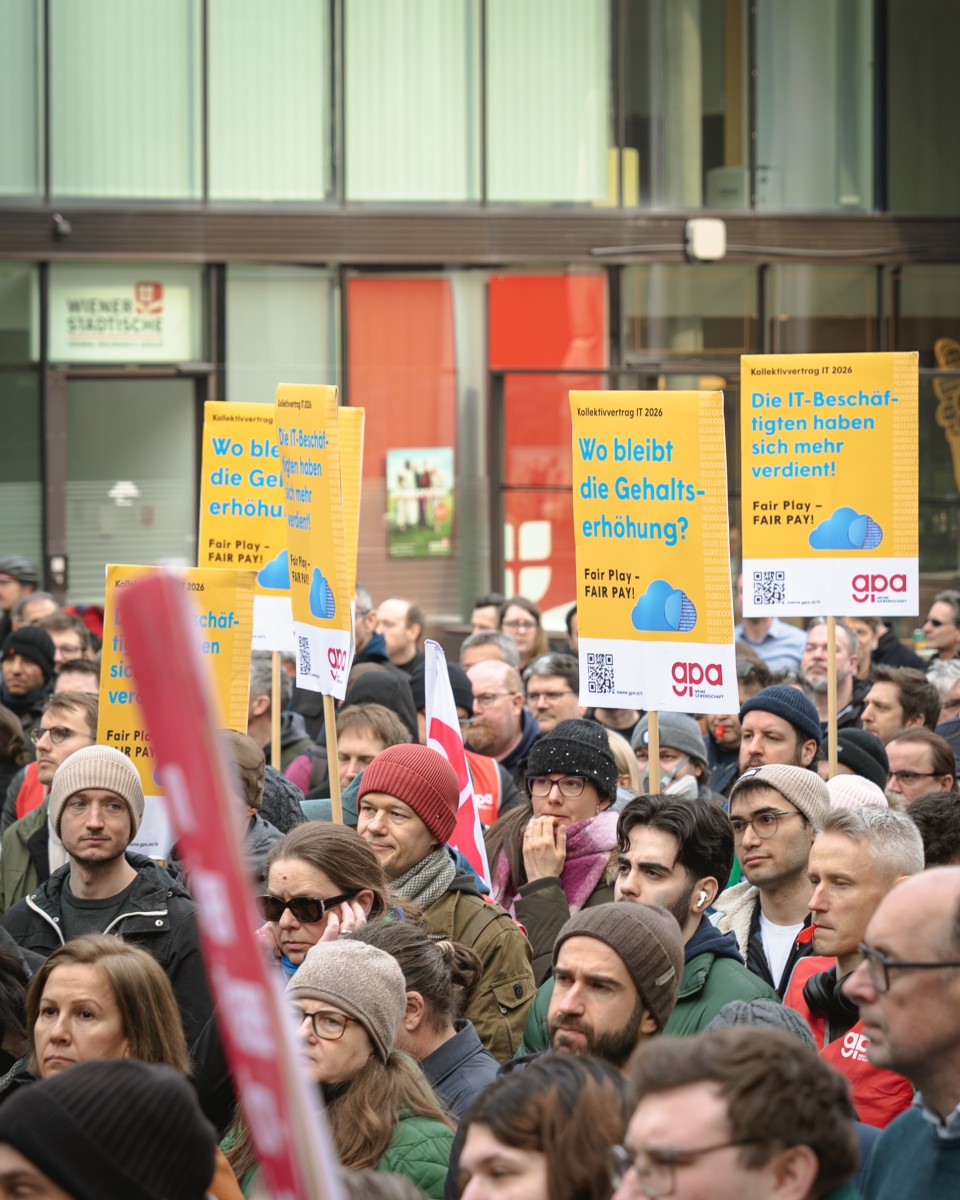
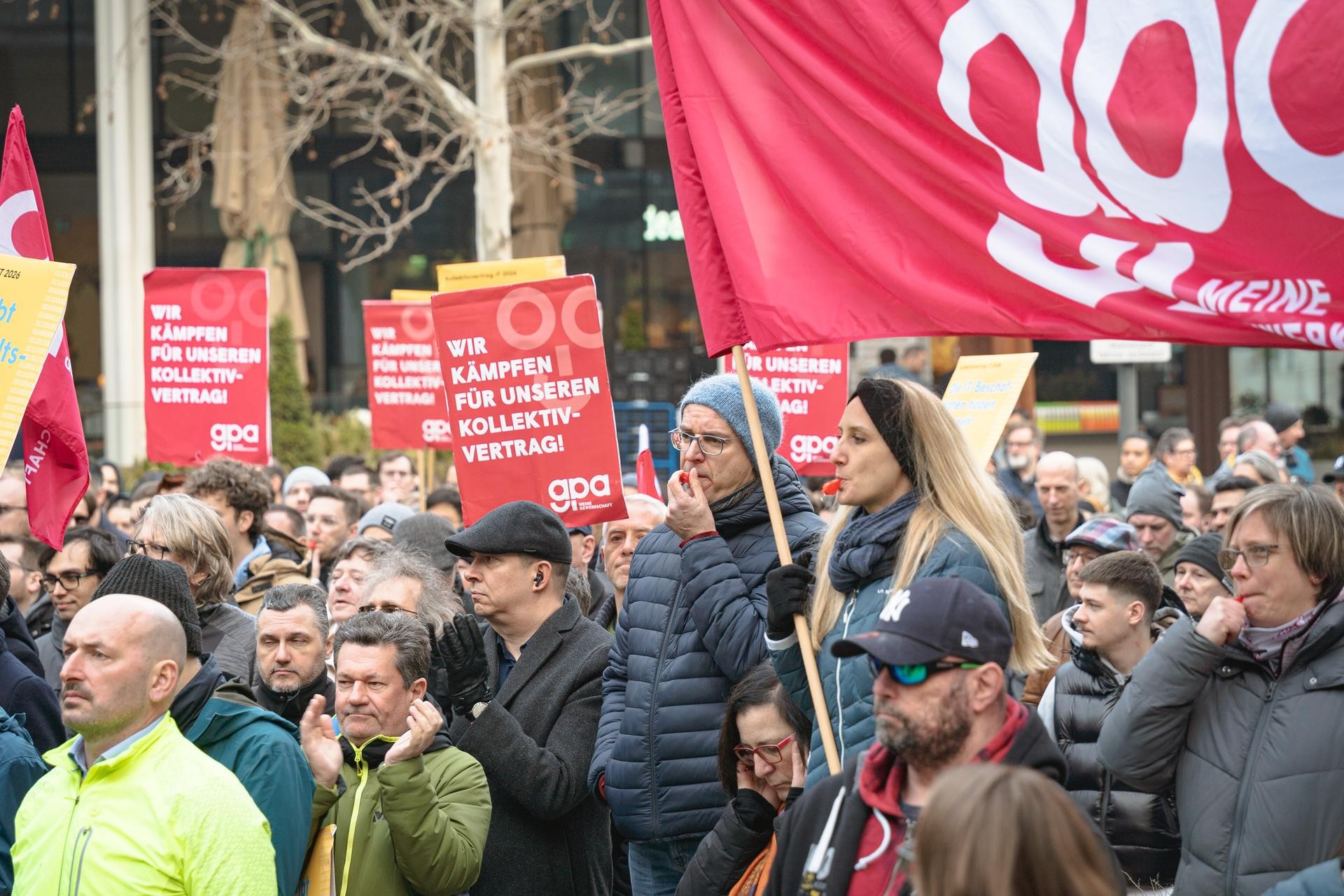
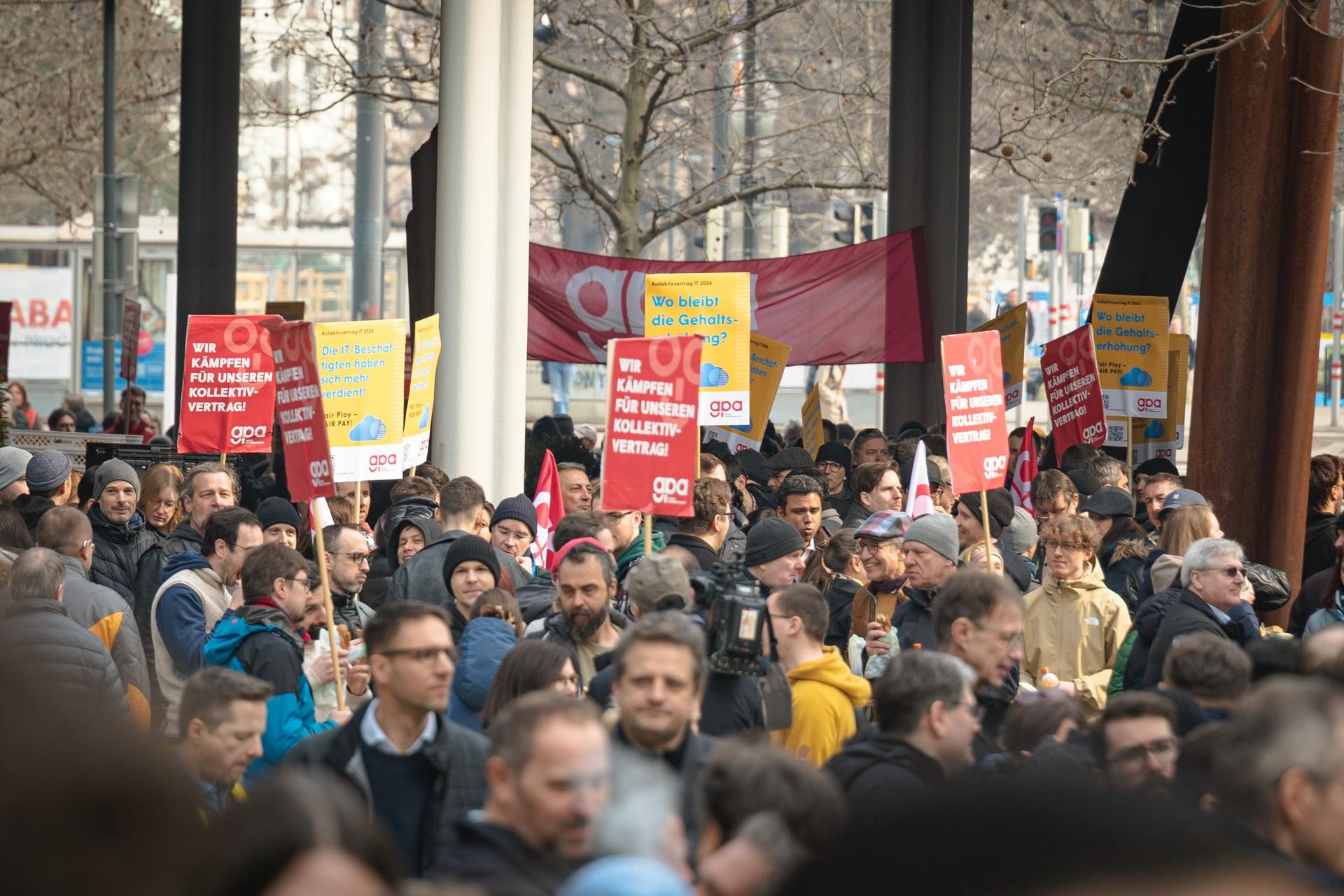
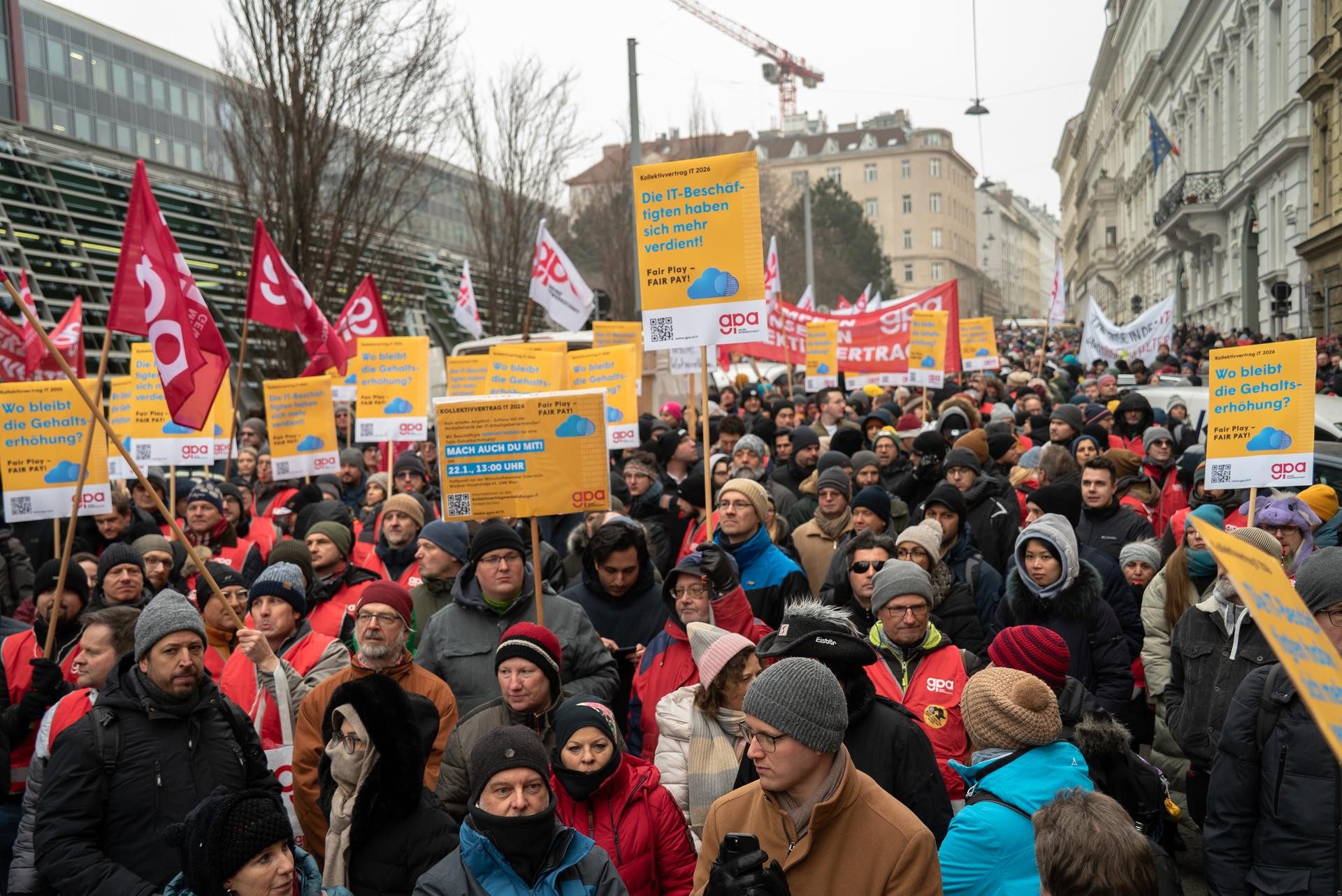
 Photo: Edgar Ketzer

 Photos: Edgar Ketzer

Why is your work in IT important to all of us?

An error has occurred. Please try again later!

Tell us what makes your work so important!
We need IT! We are important for so many things in society! 💪
Marty Cetzer
Tell us what makes your work so important!
Please enter your name and email address.
Many thanks for your submission!
Datenschutz ist für uns wichtig.
Diese E-Mail-Adresse ist neu, deshalb haben wir einen Bestätigungslink geschickt.
Also share the page with your colleagues:

Our negotiation log

November 5 - Second round of negotiations

Today, we have used facts to demonstrate why employers’ offer of +1.2% for current salaries and 2.0% for minimum salaries does not even come close to reflecting the economic growth of the IT industry.

The IT industry is projected to grow faster than the overall economy in 2026 as well. This healthy growth also builds on a track record of growth in recent years that has consistently exceeded that of the overall economy.  Outside of collective bargaining negotiations, the IT sector rightly describes itself in its public statements as a driver of growth and value creation for the Austrian economy.

We have therefore called on employers to improve their initial offer so that a negotiation process can take place.

October 19 - Start of negotiations

Negotiations for the 2027 IT Collective Bargaining Agreement began today. The annual inflation rate for 2026, which serves as the basis for the negotiations, was set at 3.2% in accordance with forecasts by WIFO and IHS.
During the negotiations, we also presented and justified our demands. We called for a 3.9% increase in minimum salaries and the sum of actual salaries. Once again this year, the regulations governing the structure of actual salaries (exceptions, etc.) will play a central role in the negotiations.
During the discussion, we explained that, unlike the economy as a whole, the IT sector has grown consistently and thus continued to gain strength. Employees deserve a corresponding raise. They perform highly skilled work and are the key factor in the IT industry’s success.
Employers have presented an offer of a 1.2% increase of the sum of actual salaries and a 2% increase in minimum salaries. This offer does not even come close to reflecting the positive economic development of the IT industry.

Our demands

  • Pay increases above inflation: Increase minimum salaries, the sum of actual salaries, apprentices’ pay and allowances by 3,9 %
  • A fairer system for actual salary increases: Improve the system by reducing exemptions, introducing guaranteed minimum increases and ensuring that no employee can be excluded from two consecutive rounds of actual salary increases.
  • 24 and 31 December off with full pay: Give all employees the right to a full day off with pay on both Christmas Eve and New Year’s Eve.
  • No disadvantage when moving to a higher job family: Ensure that employees moving from the standard level of one job family to the entry level of a higher job family never receive a lower collectively agreed minimum salary than they would have received had they remained in their previous classification.
  • The right to increase contracted hours for part-time employees: Give part-time employees who regularly work additional hours the right to increase their contracted working hours.
  • Clear rules on business travel: Clarify the definition of business travel, particularly for employees without a fixed place of work.
Do you want to support our demands?
Many thanks for your support!
Datenschutz ist für uns wichtig.
Diese E-Mail-Adresse ist neu, deshalb haben wir einen Bestätigungslink geschickt.
Also share the page with your friends:
An error has occurred. Please try again later!
You already voted!

Negotiation dates

  • October 19 - Start of negotiations
  • November 05 - Second round
  • November 23 - Third round
  • December 03 - Fourth round
  • December 12 - Fifth round
Support us by becoming a member! Learn more!

FAQs on the collective agreement negotiations:

Why is a collective agreement important?

Collective agreements ensure higher salaries and fair working conditions. In Austria, there is no statutory entitlement to wage or salary increases. Nor is there a statutory entitlement to holiday or Christmas bonuses. Trade unions secure these entitlements through annual collective agreement negotiations.

What does the collective agreement cover?

The collective agreement, negotiated by union-affiliated IT works council members, covers many entitlements that are not provided for by law or that go beyond statutory provisions.

In addition to increases to the total salary bill and minimum salaries, the IT collective agreement covers:

  • A 38.5-hour working week (statutory normal working week: 40 hours)
  • Salary grading based on duties, qualifications and length of service
  • Holiday and Christmas bonuses
  • Expense reimbursements and on-call duty allowances
Who negotiates the IT collective agreement?

A team of works council members from the IT sector negotiates the collective agreement on behalf of the GPA Union with employers represented by the Austrian Federal Economic Chamber – UBIT Trade Association.

How many employees does the IT collective agreement cover?

In Austria, around 94,000 employees are covered by the IT collective agreement. There are more than 34,000 businesses in total, but only around one fifth of them employ staff.

Is it legal to strike?

Yes, it is legal to strike in Austria. Freedom of assembly and association is protected under Article 11 of the European Convention on Human Rights. This includes the right to form or join trade unions.

Why does the collective agreement increase the total salary bill without automatically increasing my salary?

Until 2010, only minimum salaries were increased under the IT collective agreement. After tough negotiations, the GPA Union succeeded in ensuring that salaries above the minimum salary scale would also be increased from then on. However, the agreed increase is distributed individually, with scope for exceptions at company level. The GPA Union’s goal remains to make this pay model fairer.

What inflation benchmark is used to negotiate the IT collective agreement?

Each collective agreement has its own reference period for determining the inflation rate for negotiations. The resulting settlements are therefore only comparable to a limited extent. For the IT collective agreement, the autumn forecast for annual inflation issued by the IHS and WIFO economic research institutes is traditionally used as the basis.

When can a works council be established?

A works council must be elected if a company regularly employs at least five employees. To ensure that works council members can stand up for employees’ interests without fear, they are protected against dismissal.

How do I set up a works council?

You can set up a works council if there are at least five employees in your company. There are several legal steps to consider, which is why you should always establish a works council with the support of the GPA Union. Our specialists will guide you through the entire process and continue to support the elected works council members afterwards.

If you are interested in setting up a works council, please get in touch:

We are happy to help!

What exactly does a works council do?

As the link between employees and management, the works council has important duties and special responsibilities. For example, it monitors compliance with the collective agreement and can conclude works agreements on important workplace matters.

The works council also represents colleagues in disputes and can, for example, comment on terminations and dismissals and challenge them in court. It also has the right to receive information about the company’s financial situation and participate in company decision-making.

Gewerkschaft GPA

Impressum

Alfred-Dallinger-Platz 1
A-1030 Wien   

+43 / (0)5 03 01-301
service@gpa.at
www.gpa.at